
Can You Trade While Working 9-to-5? Swing Trading vs. Day Trading for Professionals

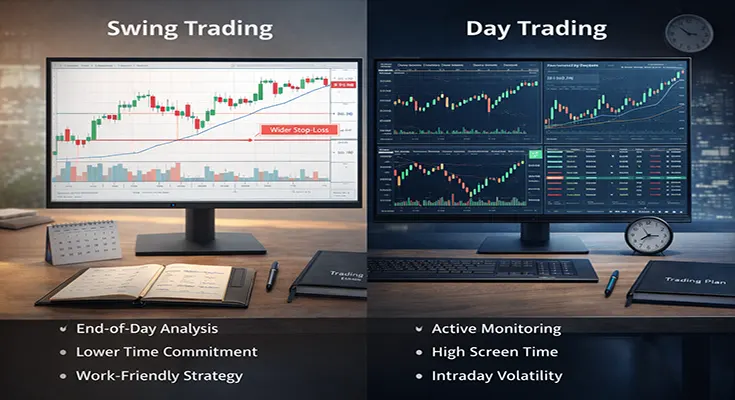
Can You Trade While Working 9-to-5? Swing Trading vs. Day Trading for Professionals

The dream is seductive: quit the rat race, fire your boss, and make a living clicking buttons on a laptop from a beach in Bali. But for most of us, the reality is a 9-to-5 job, meetings, deadlines, and a limited amount of mental energy at the end of the day.

This creates a dilemma. You want to grow your capital and generate a secondary income stream, but you cannot stare at a price chart for six hours straight without getting fired. This brings us to the ultimate debate for the part-time trader: Swing Trading vs. Day Trading.

Both strategies can be profitable, but they require vastly different lifestyles. For the working professional, choosing the wrong one isn’t just a matter of lower profits—it’s a recipe for burnout and career sabotage.

Below, we break down the pros, cons, and brutal realities of both styles to help you decide which one …

Can You Trade While Working 9-to-5? Swing Trading vs. Day Trading for Professionals Read More

Liquidity for the Soloist: The Best Unsecured Business Lines of Credit for Self-Employed Entrepreneurs

Liquidity for the Soloist: The Best Unsecured Business Lines of Credit for Self-Employed Entrepreneurs

In the “soloist” economy of 2026, the traditional path to business credit is rapidly being rewritten. For freelancers, consultants, and LLC owners, the greatest hurdle has never been their profitability, but their variability. Traditional banks often look at a “lumpy” income stream—$15,000 in January followed by $3,000 in February—and see risk.

However, an unsecured business line of credit (LOC) is designed specifically for this reality. It serves as a revolving safety net: you draw funds when cash is tight, pay interest only on what you use, and repay when the next big contract clears. By early 2026, a new wave of fintech-driven lenders has mastered the art of “data-driven” underwriting, looking past yearly tax returns to focus on real-time cash flow.

1. The Variable Income Barrier

Traditional lenders typically rely on Debt-to-Income (DTI) ratios and two years of steady tax returns. For the self-employed, this “W-2 thinking” is a …

Liquidity for the Soloist: The Best Unsecured Business Lines of Credit for Self-Employed Entrepreneurs Read More
Portfolio Defense: Choosing the Right Health Insurance to Protect Your Long-Term Investments

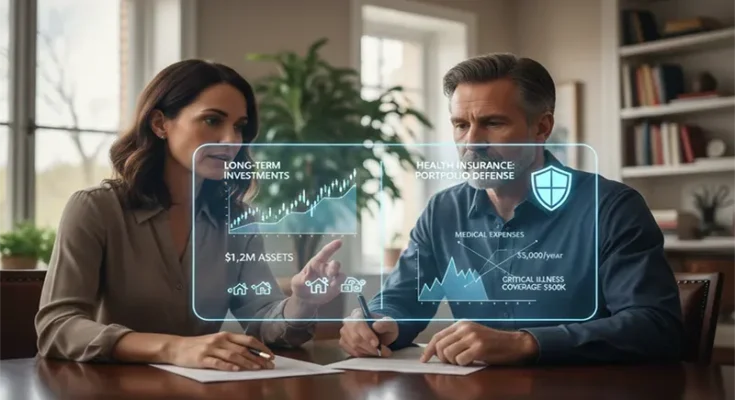
Portfolio Defense: Choosing the Right Health Insurance to Protect Your Long-Term Investments

In the sophisticated world of wealth management in 2026, the greatest threat to a long-term investment portfolio is no longer a “black swan” market crash or a spike in capital gains taxes. It is the rising cost of complex medical care. With global medical inflation projected at 10.3% this year—vastly outstripping the standard Consumer Price Index (CPI)—health insurance has transitioned from a basic utility to a critical capital preservation strategy.

For the modern investor, choosing a health policy is an exercise in risk mitigation. A single major health event without the correct coverage can force the liquidation of compounding assets at the worst possible time, effectively undoing decades of financial growth.

1. The Hidden Cost of Liquidation

When a medical emergency arises, the “sticker price” of the hospital bill is only the beginning of the financial damage. For an investor, paying a $50,000 out-of-pocket expense is not just a …

Portfolio Defense: Choosing the Right Health Insurance to Protect Your Long-Term Investments Read More
How to Read Candlestick Patterns for Crypto Day Trading

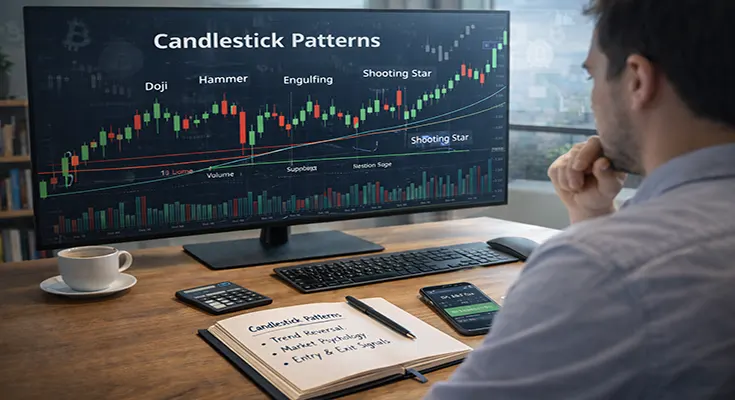
How to Read Candlestick Patterns for Crypto Day Trading

In the high-speed world of cryptocurrency, prices don’t just move; they teleport. Bitcoin can drop $1,000 in minutes, and altcoins can rally 20% while you are making coffee. For a day trader, trying to navigate this volatility without understanding price action is like trying to read a book in a language you don’t speak.

Candlestick charts are that language. They are not just lines on a screen; they are a visual representation of mass psychology—fear, greed, panic, and conviction. Unlike the stock market, which closes at night, the crypto market is a 24/7 battlefield. This makes reading candlesticks even more critical, as algorithms and global traders leave clues in the charts around the clock.

If you are tired of getting “faked out” by sudden pumps or dumps, this guide will teach you how to interpret the story behind every candle.

The Anatomy of a Crypto Candle: Decoding the Wicks

Before …

How to Read Candlestick Patterns for Crypto Day Trading Read More
Predicting Prosperity: Implementing Real-Time AI Cash Flow Forecasting for Small Business Liquidity Management

Predicting Prosperity: Implementing Real-Time AI Cash Flow Forecasting for Small Business Liquidity Management

In the volatile economic landscape of 2026, the mantra for small business survival has shifted from “profit is king” to “liquidity is life.” While a business can technically be profitable on paper, it can still fail if it lacks the cash to meet immediate obligations like payroll or vendor payments.

For decades, small business owners relied on reactive, spreadsheet-based forecasting—a method that is often “too little, too late.” Today, Real-Time AI Cash Flow Forecasting has emerged as the strategic imperative, transforming financial management from a rearview-mirror exercise into a high-definition navigation system.

1. The Small Business Cash Flow Conundrum

Traditional forecasting is plagued by the “static data” trap. Most small businesses manually export bank statements once a month, plug them into a template, and hope the next 30 days mirror the last. This manual approach is:

  • Reactive: It identifies a cash crunch only after it has begun.
  • Prone to Error:
Predicting Prosperity: Implementing Real-Time AI Cash Flow Forecasting for Small Business Liquidity Management Read More