

How to Open an RDN and Start Stock Trading for Beginners in 2026

How to Open an RDN and Start Stock Trading for Beginners in 2026

The landscape of the Indonesia Stock Exchange (IDX) has undergone a radical transformation. As of February 2026, the market is no longer just a place for “institutional giants”; it has become a digitized arena designed for the retail investor. Following the landmark 2025 Market Reforms, which tightened transparency and mandated higher “Free Float” standards, the barrier to entry has vanished. If you have a smartphone and an e-KTP, you are essentially 15 minutes away from owning a piece of Indonesia’s largest companies.

Starting your investment journey today requires understanding the new “Golden Rule” of 2026: wealth is built through RDN-integrated ecosystems. Gone are the days of manual bank transfers and three-day waiting periods. In 2026, your bank account and your brokerage account live in the same digital house.

The 2026 Landscape: The Era of the Retail Investor

The most significant change in 2026 is the Lighthouse IPO initiative …

How to Open an RDN and Start Stock Trading for Beginners in 2026 Read More

Calculating the Long-Term ROI of Migrating Legacy Financial Systems to Cloud-Native ERP Platforms

Calculating the Long-Term ROI of Migrating Legacy Financial Systems to Cloud-Native ERP Platforms

For many CFOs, the legacy financial system is a “comfortable” burden. It is paid for, the team knows its quirks, and it has successfully closed the books for a decade. however, in the 2026 economy, “stable” is often a synonym for “stagnant.” As global markets accelerate and real-time data becomes the primary currency of business, the cost of maintaining monolithic, on-premise ERPs is quietly eroding corporate margins.

Migrating to a cloud-native ERP platform is a high-friction, capital-intensive decision. To justify such a shift, leadership must look beyond the sticker price of a SaaS subscription. True ROI in this context is found at the intersection of technical debt reduction, operational elasticity, and the strategic value of data liquidity.

The Hidden Costs of “Staying Put”: The Legacy Tax

The most significant barrier to migration is often the misconception that a legacy system is “free” because the initial capital expenditure (CapEx) has been …

Calculating the Long-Term ROI of Migrating Legacy Financial Systems to Cloud-Native ERP Platforms Read More
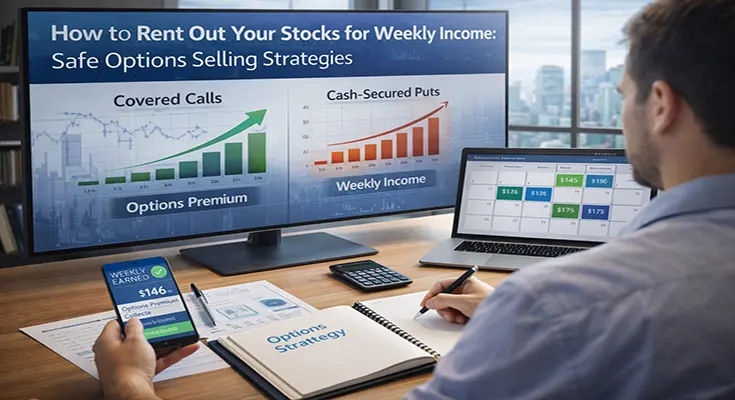
How to Rent Out Your Stocks for Weekly Income: Safe Options Selling Strategies

How to Rent Out Your Stocks for Weekly Income: Safe Options Selling Strategies

Most investors view the stock market as a place to buy low and sell high. They buy a stock, cross their fingers, and hope it goes up. If the market stays flat or drops, they make nothing (or lose money).

But there is a different way to play the game. Instead of being the Gambler hoping for a lucky break, you can be the Casino.

Options selling (also known as “writing” options) allows you to generate consistent cash flow regardless of whether the market is booming or boring. By utilizing Time Decay (Theta), you can profit simply because time passes. While high-risk traders buy options hoping for lottery-ticket returns, smart income investors sell options to generate reliable, “boring” weekly checks.

Here are the safest strategies to generate weekly income while protecting your capital.

The Foundation: The Cash-Secured Put (CSP)

The Cash-Secured Put is the starting point for most …

How to Rent Out Your Stocks for Weekly Income: Safe Options Selling Strategies Read More
Calculating CAGR and Mutual Fund Performance for Long-Term Wealth Building

Calculating CAGR and Mutual Fund Performance for Long-Term Wealth Building

In the world of investing, there is a dangerous phenomenon known as the “Wealth Illusion.” Imagine an investor who boasts that their portfolio has grown by 100%. On the surface, doubling your money sounds like a resounding success. However, if that growth took 20 years to achieve, the investor has actually underperformed basic inflation-adjusted benchmarks. Without a standardized way to measure time and growth together, investors often find themselves chasing “hot” returns that offer very little substance over the long haul.

To build sustainable wealth, you must move beyond looking at “total gains” and start looking at the Compound Annual Growth Rate (CAGR). It is the most reliable yardstick for measuring the performance of mutual funds and individual portfolios over time. By smoothing out the volatile “peaks and valleys” of the stock market, CAGR provides the mathematical truth of how hard your money is actually working for you.

The

Calculating CAGR and Mutual Fund Performance for Long-Term Wealth Building Read More
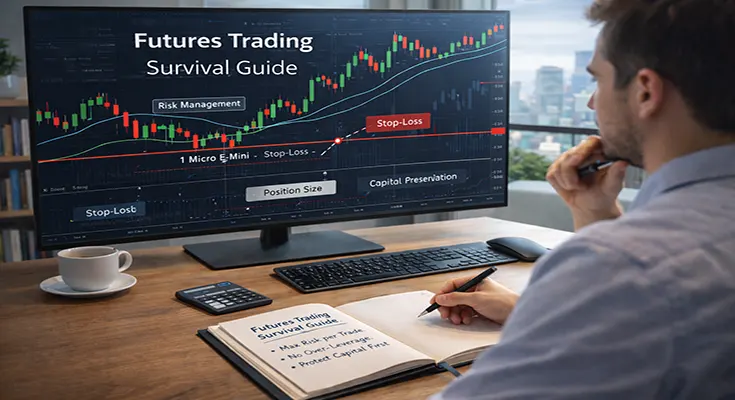
How to Trade Futures Without Blowing Your Account: A Survival Guide

How to Trade Futures Without Blowing Your Account: A Survival Guide

Let’s be brutally honest: High leverage is not a tool for wealth creation for 99% of people; it is a tool for rapid wealth destruction.

If you are reading this, you are likely drawn to the allure of 50x or 100x leverage—the ability to turn $1,000 into $100,000 in a month. But in the futures market, leverage is a double-edged sword that cuts significantly deeper on the way down. Statistics show that over 90% of retail futures traders lose their entire deposit within the first 90 days.

They fail not because they can’t read a chart, but because they do not respect the mathematics of ruin.

If you want to be in the surviving 10%, you must stop acting like a gambler and start acting like a risk manager. Here are the non-negotiable rules for high-leverage futures trading.

The Mathematics of Ruin: Understanding Liquidation

Before you place a trade, you …

How to Trade Futures Without Blowing Your Account: A Survival Guide Read More