
Let’s be brutally honest: High leverage is not a tool for wealth creation for 99% of people; it is a tool for rapid wealth destruction.
If you are reading this, you are likely drawn to the allure of 50x or 100x leverage—the ability to turn $1,000 into $100,000 in a month. But in the futures market, leverage is a double-edged sword that cuts significantly deeper on the way down. Statistics show that over 90% of retail futures traders lose their entire deposit within the first 90 days.
They fail not because they can’t read a chart, but because they do not respect the mathematics of ruin.
If you want to be in the surviving 10%, you must stop acting like a gambler and start acting like a risk manager. Here are the non-negotiable rules for high-leverage futures trading.
The Mathematics of Ruin: Understanding Liquidation
Before you place a trade, you must understand exactly how close you are to death (liquidation).
Leverage dictates your “breathing room.” It compresses the distance between your entry price and your liquidation price.
- 10x Leverage: A 10% move against you wipes the account.
- 50x Leverage: A 2% move against you wipes the account.
- 100x Leverage: A 1% move against you wipes the account.
In volatile markets like Crypto or Nasdaq Futures (NQ), a 1% move can happen in seconds. If you are using 100x leverage, you are essentially flipping a coin in a minefield. You are not trading; you are praying.
The Slippage Factor:
Never assume your Stop Loss will save you perfectly. In a “flash crash,” liquidity evaporates. If you set a stop at $20,000, but the price gaps down, your order might fill at $19,800. On high leverage, that small slip can result in a total loss even if you had a stop in place.
Rule 1: Position Sizing (The Holy Grail)
Most beginners ask, “How much leverage should I use?” This is the wrong question.
The right question is: “How much money am I risking on this specific setup?”
High leverage allows you to open a large position with little capital, but that doesn’t mean you should use your entire balance.
The Golden Formula
Your position size should not be determined by your feelings, but by this formula:
$$\text{Position Size} = \frac{\text{Account Size} \times \text{Risk \%}}{\text{Stop Loss Distance \%}}$$
Example:
- Account Size: $10,000
- Max Risk: 2% ($200)
- Stop Loss Distance: 1% away from entry.
$$\text{Position Size} = \frac{10,000 \times 0.02}{0.01} = \$20,000$$
In this scenario, you are trading a $20,000 position. Since you have $10,000 cash, you are effectively using 2x Leverage. Even if the exchange allows you to use 100x, using more than 2x here would violate your risk rule.
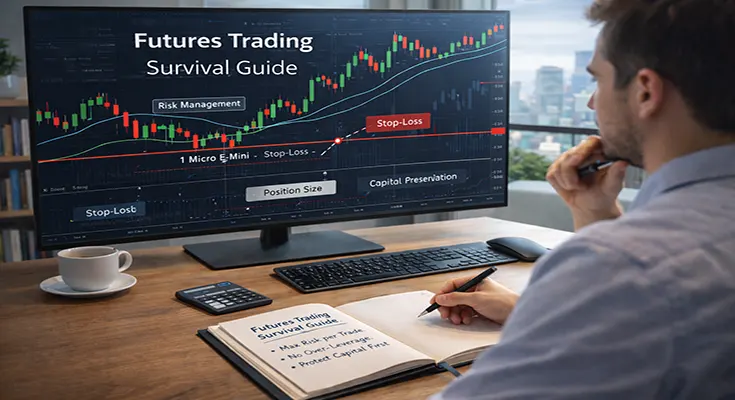
Rule: Never size a position so that a stop-loss hit costs you more than 1-2% of your total equity.
Rule 2: The “Hard” Stop Loss
In spot trading, you can hold a losing “bag” for years hoping it comes back. In futures, the market will take your collateral long before the price comes back.
Mental stops are suicide.
When the price approaches your mental stop, your brain will invent excuses: “It’s just a wick, I’ll give it a little more room.”
Five minutes later, you are liquidated.
The Protocol:
- Analyze the chart.
- Identify your invalidation point (where the trade idea is wrong).
- Place the Stop Loss order simultaneously with your Entry order.
- Never move a stop loss further away to prevent it from being hit.
Rule 3: Daily Circuit Breakers
Revenge trading is the fastest way to $0. After a painful loss, your brain is flooded with cortisol and adrenaline. You want the money back now. You double your position size, enter impulsively, and lose again.
You need a Circuit Breaker—a hard rule that forces you to walk away.
The 3-Strike Rule:
- Max Daily Loss: 3% of Account Balance.
- If you lose 3% in a single day, you are banned from opening the terminal for 24 hours.
This rule saves you from the “death spiral” where a bad morning turns into a blown account by the afternoon.
Rule 4: Cross Margin vs. Isolated Margin
Your exchange offers two margin modes. Knowing the difference is critical for asset protection.
Cross Margin (The Default Trap)
In Cross Margin, your entire account balance is used as collateral for your open positions.
- Danger: If you have one open trade that goes drastically wrong (e.g., a flash crash while you sleep), it can drain your entire wallet balance to keep the position open. You lose everything.
Isolated Margin (The Firewall)
In Isolated Margin, only the funds allocated to that specific position are at risk.
- Safety: If you put $100 into a trade on Isolated Margin and it gets liquidated, you lose only that $100. The remaining $9,900 in your wallet is safe.
Recommendation: strictly use Isolated Margin for high-leverage plays. It acts as a natural firewall for your capital.
The Psychology of High Leverage
High leverage triggers the same dopamine receptors as a slot machine. When you see PnL (Profit and Loss) swinging by 50% in seconds, you are no longer analyzing the market; you are reacting to emotional impulses.
You must cultivate Emotional Detachment.
If your heart races when you enter a trade, your position size is too big.
If you can’t sleep because you have an open position, your leverage is too high.
Successful futures trading is boring. It is a repetitive execution of math and probability. If it feels exciting, you are likely doing it wrong.
In futures trading, your first job is Risk Manager. Your second job is Trader.
Anyone can get lucky and turn $1,000 into $10,000 using 50x leverage. But without these rules, they will inevitably give it all back. The market is designed to transfer money from the impatient to the disciplined.
The Summary Checklist:
- Never risk more than 1-2% of your account on a single trade.
- Always use a hard Stop Loss; never rely on mental stops.
- Use Isolated Margin to firewall your funds.
- Walk away if you hit your daily loss limit.
Respect the leverage, or the leverage will remove you from the game.