
If you have $100 or $500 to start trading, you might feel like a small fish in a massive ocean. You might worry that without thousands of dollars in capital, you can’t make meaningful profits or that the “big players” will simply wipe you out.
Here is the truth: You do not need a massive account to be a successful forex trader. In fact, starting small is often the best way to learn the discipline required for long-term survival. The real challenge isn’t the size of your account; it’s the size of your patience.
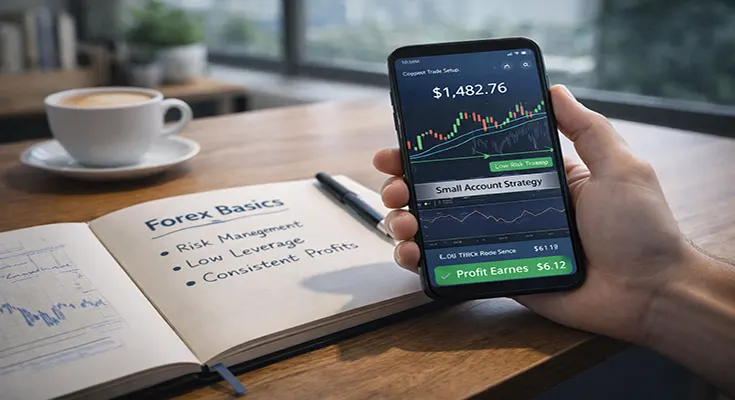
For beginners with small accounts, the goal shouldn’t be to “get rich quick.” It should be to survive, learn, and compound small gains over time. By using micro-lots (0.01 lots), you can trade with minimal risk while learning how the market moves. However, a small account does require a different approach than a large one. You cannot afford to absorb large losses, so precision and strategy are everything.
Below, we cover three specific strategies tailored for small accounts—Scalping, Swing Trading, and Breakout Trading—along with the critical psychology needed to make them work.
The Psychology of Small Accounts: Patience Over Profits
Before diving into charts, we must address the “small account trap.”
When you see a profit of $0.50 or $2.00, it’s easy to feel discouraged. You might think, “At this rate, it will take me 50 years to buy a Lamborghini.” This frustration often leads beginners to over-leverage—using too much borrowed money to open positions that are too large for their balance.
- The Trap: You risk 10% or 20% of your account on a single trade to try and double your money fast.
- The Reality: One bad trade wipes you out.
The Solution: Treat your $100 account as if it were $100,000. If you can consistently grow $100 by 5% a month, you can do the same with $100,000. Focus on the percentage of growth, not the dollar amount.
Strategy 1: Scalping with the 5-Minute Chart
Scalping is the art of taking small profits frequently. For small accounts, this is appealing because it allows you to compound your account balance faster than waiting days for a single trade to play out.
Why it Works for Small Accounts
Scalping relies on small price movements. You don’t need the market to move 100 pips; you only need it to move 5 or 10 pips. This reduces your exposure time to the market, lowering the risk of a sudden news event blowing up your trade.
The “RSI + Moving Average” Setup
This simple strategy uses two indicators to filter out noise.
- Timeframe: 5-Minute Chart.
- Indicators:
- 200-period Exponential Moving Average (EMA): Determines the trend.
- Relative Strength Index (RSI): Measures momentum (Settings: 14 periods).
The Rules:
- Identify the Trend: If the price is above the 200 EMA, only look for Buy trades. If price is below the 200 EMA, only look for Sell trades.
- Wait for the Pullback:
- For Buys: Wait for the price to dip and the RSI to drop below 30 (Oversold).
- For Sells: Wait for the price to rally and the RSI to go above 70 (Overbought).
- Entry Trigger: Enter as soon as the price starts to turn back in the direction of the trend.
- Exit: Take profit at 10-15 pips. Set your Stop Loss at 10 pips.
Note: Scalping requires a broker with low spreads (fees). If your broker charges 3 pips spread, scalping is mathematically impossible.
Strategy 2: Swing Trading Daily Trends
If you have a full-time job and can’t stare at charts all day, scalping is dangerous. Swing trading is the better alternative. You analyze the charts once a day, set your orders, and walk away.
Why it Works for Small Accounts
Swing trading usually targets major pairs like EUR/USD or GBP/USD. These pairs are stable and have high liquidity, meaning you won’t get stuck in a trade you can’t exit.
The “Trend Follower” Setup
This strategy focuses on catching the “meat” of a move in the middle of a trend.
- Timeframe: Daily (D1) or 4-Hour (H4) chart.
- Tools: Support and Resistance lines.
The Rules:
- Zoom Out: Look at the Daily chart. Is the market making “Higher Highs” (Uptrend) or “Lower Lows” (Downtrend)?
- Mark the Zone: Draw a line at the most recent Support or Resistance level.
- The Entry: Wait for the price to come back to your line. Do not enter blindly. Wait for a “rejection candle”—like a Pin Bar or a Hammer—that shows the price is bouncing off that level.
- The Trade: Enter on the next candle.
- Risk Management: Place your stop loss below the rejection candle. Target a profit that is at least 2x your risk (e.g., Risk $5 to make $10).
Strategy 3: The ‘London Breakout’ Strategy
The forex market is most active when the London and New York sessions overlap (roughly 8:00 AM to 12:00 PM EST). This strategy captures the explosive volatility that happens when these big markets open.
Why it Works for Small Accounts
Volatility means movement. A small account needs movement to grow. This strategy often catches 20-40 pips in a single morning.
The Rules:
- Define the Range: Look at the price action of the GBP/USD during the Asian session (before London opens). Draw a box around the High and Low of the last 4 hours before the London Open (3:00 AM EST).
- Wait for the Break: You are waiting for the price to “break out” of this box.
- The Trap Prevention: Often, price will fake a breakout and reverse. To avoid this, wait for a 15-minute candle to CLOSE outside of your box.
- Entry: Enter in the direction of the breakout.
- Stop Loss: Place your stop loss back inside the middle of the box range.
Crucial Risk Management Rules for Small Accounts
You can have the best strategy in the world, but without risk management, you will hit $0.
1. The 1% Rule
Never risk more than 1% of your account on a single trade.
- If your account is $100, your max loss is $1.
- If your account is $500, your max loss is $5. This seems tiny, but it ensures you can survive a losing streak of 10 or 20 trades without blowing your account.
2. Respect the Stop Loss
A Stop Loss is not a suggestion; it is your insurance policy. Never move your stop loss further away to “give the trade room.” That is how small losses turn into account-destroying disasters.
3. Watch the News
Avoid trading during “High Impact” news events (like NFP or CPI data releases). These events cause massive spikes that can jump right over your stop loss. Use a free economic calendar to know when these events are happening.
Conclusion
Trading with a small account is a journey of discipline. It forces you to be precise and patient—skills that will make you a formidable trader when your capital grows.
Start with Swing Trading if you are busy, or Scalping if you have time to focus. Stick to the 1% rule religiously. Remember, the market will always be there tomorrow. Your goal is to ensure your capital is there too.
Ready to start? Open a Demo Account today and practice the “RSI + Moving Average” strategy for two weeks before risking a single real dollar. Good luck!