

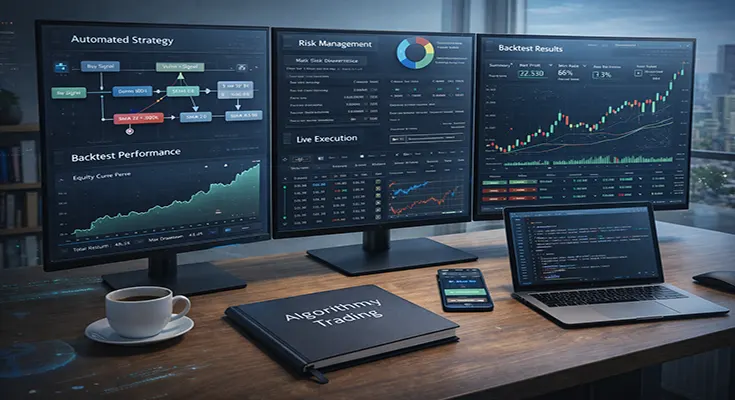
For decades, algorithmic trading was the exclusive playground of Wall Street. High-frequency trading firms, hedge funds, and institutional banks spent billions on infrastructure to shave milliseconds off execution speeds. The average retail investor was left manually clicking “Buy” and “Sell,” often reacting to news long after the algorithms had already priced it in.
That era is over. Today, the democratization of financial technology has brought institutional-grade tools to the retail market. Whether you are a python-coding engineer or a complete beginner looking for a “drag-and-drop” solution, there is now software that allows you to automate your trading strategy.
Algorithmic trading software does not just “make money” for you; it executes a specific set of rules without emotion, fatigue, or hesitation. It ensures that if your strategy says “sell at $150,” the order is executed at $150—instantly—while you are at work or asleep.
Below, we review the top-rated algorithmic trading platforms available to retail investors today, categorized by user skill level and asset class.
How to Choose: Selection Criteria
Before downloading the first tool you see, you must define your needs. Not all “bots” are created equal. When reviewing these platforms, we focused on three critical factors:
- Code vs. No-Code: Do you know Python, C++, or C#? Or do you need a visual interface where you can drag blocks together to build a strategy?
- Backtesting Capabilities: The most important feature of any software is the ability to test your idea on historical data. If you cannot prove your strategy worked in the past (backtesting), you should not trust it with your money in the future.
- Broker Integration: Great software is useless if it cannot connect to your broker. Some tools require complex API keys, while others have built-in connections.
1. The Standard for Forex & CFDs: MetaTrader 4 & 5 (MT4/MT5)
If you are trading Forex, Gold, or Indices, MetaTrader remains the undisputed king of retail algorithmic trading. Despite its dated interface, it powers the vast majority of retail brokers globally.
- Type: Desktop Application (Windows/Mac).
- Language: MQL4 or MQL5 (proprietary languages similar to C++).
Why It Is Top-Rated
- The Marketplace: MT4/MT5 has the largest library of third-party “Expert Advisors” (EAs) in the world. If you cannot code, you can hire a freelancer on the MQL5 community market to build your strategy for $50-$100.
- Cost: It is completely free to use with almost any Forex broker.
- Execution: The software runs locally on your machine (or a VPS), offering robust execution speeds.
The Drawbacks
- Steep Learning Curve: Learning MQL4/5 is difficult for non-programmers.
- Old Tech: The backtesting engine in MT4 is single-threaded and slow compared to modern cloud solutions. MT5 improves on this, but the user experience still feels like Windows 98.
2. Best for Chartists & Scripters: TradingView
TradingView started as a charting platform but has evolved into a powerhouse for strategy development. It is ideal for traders who want to visually identify setups and then automate them.
- Type: Cloud-based (Browser).
- Language: Pine Script (specifically designed for trading, very easy to learn).
Why It Is Top-Rated
- Visual Backtesting: This is TradingView’s “killer feature.” You can write a script in Pine Script (e.g., “Buy when RSI < 30”) and instantly see the results overlaid on your chart. It shows you exactly where the buy and sell signals would have fired.
- Cloud Convenience: There is nothing to install. Your charts and scripts are saved in the cloud and accessible from any device.
- Community Scripts: You can access thousands of open-source strategies published by other users to learn from or modify.
The Drawbacks
- Execution is Tricky: TradingView does not natively execute trades for many brokers. To automate fully, you often need to send “Webhooks” (signals) to a third-party bridge (like 3Commas or a custom server) to actually place the trade. This adds a layer of complexity.
3. Best for Crypto & No-Code Users: 3Commas / Cryptohopper
The cryptocurrency market runs 24/7, making it the perfect environment for automation. 3Commas and Cryptohopper are the leaders in this space, specifically designed for users who want to trade crypto without writing a single line of code.
- Type: Cloud-based (Browser/App).
- Language: None (Visual Drag-and-Drop).
Why It Is Top-Rated
- Grid Bots & DCA: These platforms excel at specific automated strategies like “Grid Trading” (buying and selling at set intervals in a sideways market) and “Dollar Cost Averaging” (DCA).
- Exchange Integration: They connect via API to all major crypto exchanges (Binance, Coinbase, Kraken, Bybit). You simply plug in your API keys, and the bot trades your funds on the exchange.
- Social Trading: You can copy the bot configurations of successful traders on the platform (though past performance is not indicative of future results).
The Drawbacks
- Monthly Subscription: Unlike MetaTrader, these are SaaS (Software as a Service) platforms. You pay a monthly fee (often $20-$100) to use the advanced bots.
- Security Risks: You are entrusting your exchange API keys to a third-party platform. While they are generally secure, centralized hacks are a theoretical risk.
4. Best for Aspiring Quants (Advanced): QuantConnect
For those with coding skills (Python or C#) who want institutional-grade power, QuantConnect is the gold standard for retail quants.
- Type: Cloud-based & Local (LEAN Engine).
- Language: Python, C#.
Why It Is Top-Rated
- Data Quality: QuantConnect provides access to terabytes of free financial data (tick data, fundamental data, alternative data) that would cost thousands of dollars elsewhere.
- The LEAN Engine: Their open-source engine, LEAN, is incredibly powerful. It accounts for “slippage,” trading fees, and spread widening, giving you realistic backtest results rather than theoretical ones.
- Cross-Asset Class: You can build algorithms that trade Equities, Options, Futures, Forex, and Crypto all in the same strategy.
The Drawbacks
- High Barrier to Entry: This is not for beginners. You need to be a competent programmer to use this platform effectively.
The “Black Box” Warning
A critical warning for all retail investors: Do not confuse “Algorithmic Trading Software” with “Get Rich Quick Bots.”
The internet is full of websites selling “Black Box” algorithms—USB drives or downloadable files that promise “95% win rates” and “guaranteed daily returns.”
- The Scam: These sellers show you a “backtest” that looks perfect. Usually, this is achieved by “curve fitting”—tweaking the parameters so they fit past data perfectly but fail miserably in the live market.
- The Reality: If someone had an algorithm that truly generated guaranteed risk-free money, they would not sell it to you for $50. They would run it themselves on a compounding loop.
Use the software mentioned above to build your own strategy or automate a logic you understand. Never trust a black box where you cannot see the code.
Best Software
The “best” software depends entirely on your resources and your goals.
- The Forex Trader: Stick with MetaTrader 4/5. It’s the industry standard for a reason.
- The Visual Learner: Start with TradingView. Learning Pine Script is the single best investment of time a retail trader can make.
- The Crypto Holder: Use 3Commas or Cryptohopper to automate your accumulation or grid trading 24/7.
- The Coder: Go to QuantConnect. It offers the most robust testing environment available to the public.
Automation is a tool, not a magic wand. The software will execute a bad strategy just as efficiently as a good one. Start by backtesting your ideas, run them on a demo account, and only turn on the live “Auto-Trade” switch when you have proven the edge exists.