
The dream is seductive: quit the rat race, fire your boss, and make a living clicking buttons on a laptop from a beach in Bali. But for most of us, the reality is a 9-to-5 job, meetings, deadlines, and a limited amount of mental energy at the end of the day.
This creates a dilemma. You want to grow your capital and generate a secondary income stream, but you cannot stare at a price chart for six hours straight without getting fired. This brings us to the ultimate debate for the part-time trader: Swing Trading vs. Day Trading.
Both strategies can be profitable, but they require vastly different lifestyles. For the working professional, choosing the wrong one isn’t just a matter of lower profits—it’s a recipe for burnout and career sabotage.
Below, we break down the pros, cons, and brutal realities of both styles to help you decide which one fits your schedule.
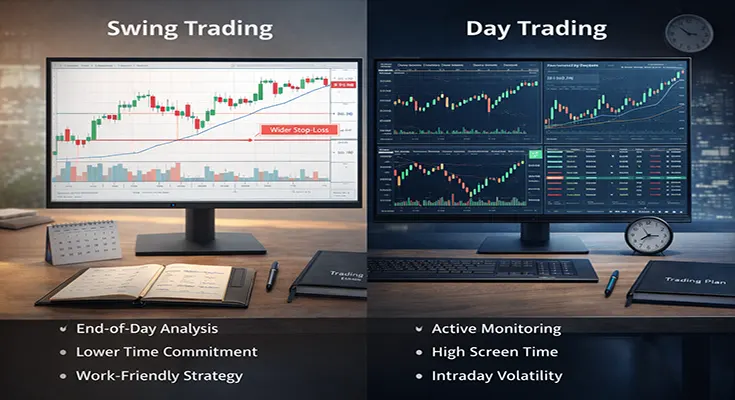
Day Trading: The “Second Job” Approach
Definition: Day trading involves buying and selling financial instruments within the same trading day. All positions are closed before the market closes.
The Appeal (Pros)
- No Overnight Risk: You sleep soundly knowing you hold zero positions. If the market crashes overnight due to a geopolitical crisis, your cash is safe.
- Instant Gratification: You know exactly how much you made (or lost) by the time you log off. The feedback loop is immediate.
- High Frequency: You can compound small gains quickly because you are taking multiple trades a day.
The Reality for Professionals (Cons)
For a person with a full-time job, day trading presents massive logistical hurdles.
- The “Meeting” Conflict: Day trading requires intense focus. The best moves often happen during the market open (9:30 AM – 11:00 AM EST). If you have a team meeting or a client call during that window, you miss the trade. Trying to trade secretly on your phone under the desk is a fast way to lose money.
- High Stress: Day trading is mentally exhausting. Making rapid-fire decisions about money while simultaneously trying to perform at your day job leads to “decision fatigue.” You will likely perform poorly at both.
- The Noise: Lower timeframes (1-minute or 5-minute charts) are full of “noise” and fakeouts. Navigating this requires a level of screen time that most employees simply cannot afford.
The Verdict: For 95% of working professionals, day trading is unsustainable. It essentially acts as a second, high-stress job that competes for your attention during your primary working hours.
Swing Trading: The “Passive Income” Approach
Definition: Swing trading involves holding positions for days or weeks to capture a significant “swing” or move in the market trend. You might buy on Monday and sell on Thursday.
The Appeal (Pros)
- Time Freedom: This is the biggest selling point. You do not need to watch the screen all day. Price action on higher timeframes (4-Hour or Daily charts) moves slowly. You can check your trades once or twice a day.
- Big Picture Analysis: You filter out the intraday noise. You aren’t worried about a 10-cent fluctuation; you are looking for a $5 move.
- Analysis on Your Schedule: You can do your chart analysis when the market is closed—on evenings or weekends. This completely removes the conflict with your 9-to-5 job.
The Risks (Cons)
- Overnight Risk: Because you hold trades for days, you are exposed to “gap risks.” If a company announces bad earnings or a war breaks out while you are sleeping, the market could open significantly lower than where it closed, bypassing your stop loss.
- Patience Required: You might go days without finding a setup. Once in a trade, you must have the discipline to sit on your hands and let the trade work, even if it moves slowly.
The Verdict: Swing trading is the sweet spot for professionals. It allows you to participate in the markets without hijacking your daily life.
Comparison: The Reality Check
Here is how the two styles stack up against the constraints of a full-time career:
| Feature | Day Trading | Swing Trading |
| Time Required | 3-6 hours/day (during work hours) | 3-5 hours/week (evenings/weekends) |
| Stress Level | Extremely High | Moderate to Low |
| Chart Speed | Fast (1-min to 15-min charts) | Slow (4-hour to Weekly charts) |
| Capital Impact | Fees eat into small profits | Spreads/Fees are negligible on larger moves |
| Career Conflict | High (Must watch market live) | Low (Can automate entries) |
An Actionable Strategy for the Working Trader
If you have a job but want to trade, stop trying to scalp the 5-minute chart during your bathroom breaks. Instead, adopt a “Weekend Warrior” Swing Strategy.
1. The Sunday Setup
Dedicate 1-2 hours on Sunday evening to scan the markets. Look at the Weekly and Daily charts of major assets (Stocks, Forex pairs, or Crypto). Identify key Support and Resistance levels.
2. Set “Limit Orders”
Instead of staring at the screen waiting for the price to hit your level, place Limit Orders (pending orders).
- Example: “If Apple drops to $150, buy automatically.”This allows you to “enter” the market while you are sitting in a Monday morning meeting or driving to work.
3. The “Lunch Break” Check-in
Check your positions once a day, perhaps during your lunch break.
- Did your order trigger?
- Is the price moving in your favor?
- Do nothing else. Do not micromanage the trade. If your Stop Loss and Take Profit are set, let the market do the work.
4. Use Alerts
Set price alerts on your phone. If a critical level is breached, you get a notification. This keeps you informed without gluing you to the screen.
The Goal
The goal of trading is to gain financial independence, not to chain yourself to another desk.
For the working professional, Day Trading is often a trap—a high-stress, time-consuming endeavor that clashes with career responsibilities. Swing Trading, however, offers a realistic path. It respects your time, utilizes the stability of higher timeframes, and allows your money to work for you while you are busy working for someone else.
Don’t quit your job to become a trader. Become a Swing Trader so you eventually can quit your job. Start this Sunday: open the Daily chart, zoom out, and look for the big picture.